
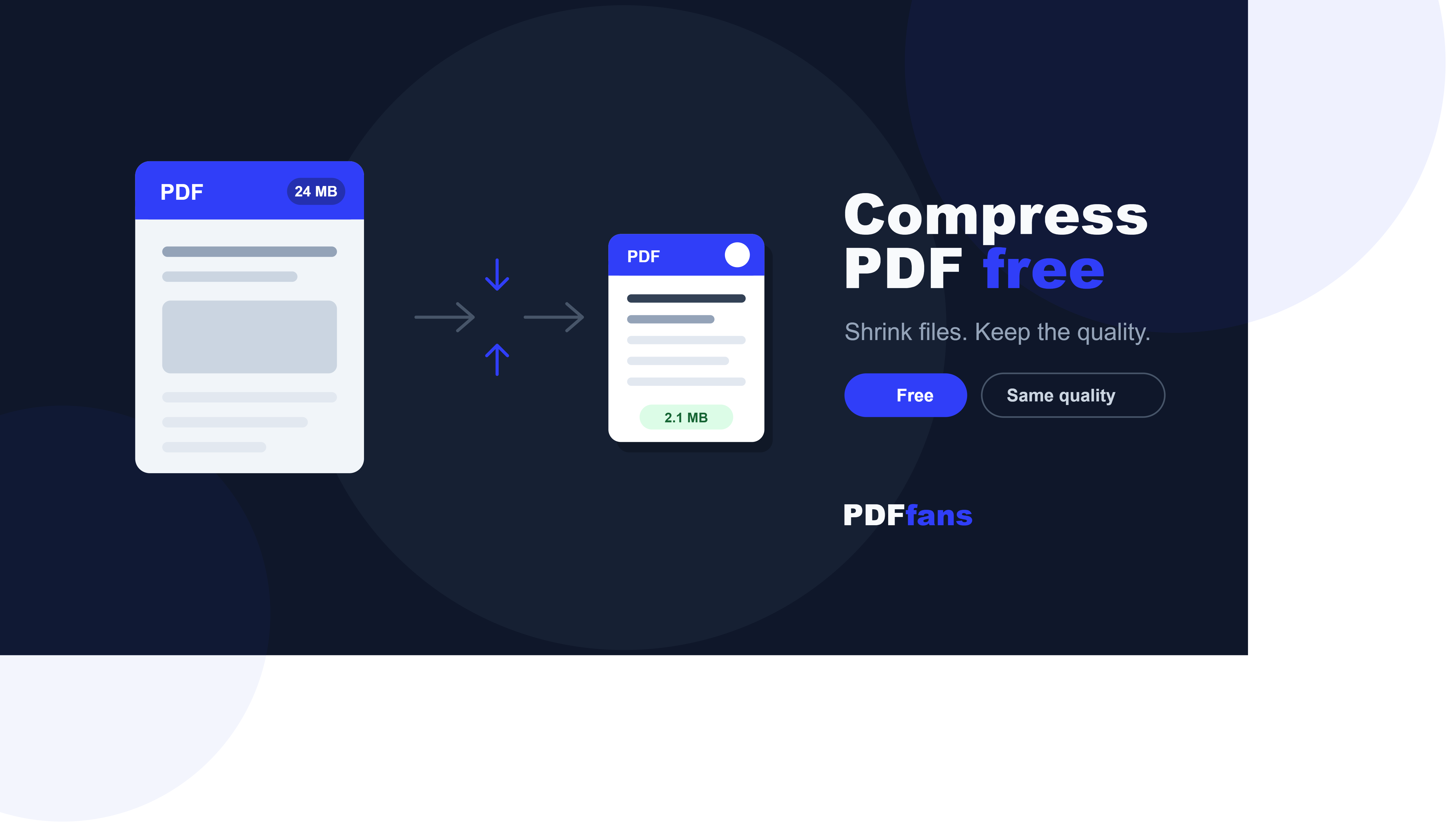
Your PDF is 24 MB. The upload form says the limit is 10. Or the email bounces back because the attachment is too big. Sound familiar? Whether it's a scanned contract, a photo-heavy report, or a portfolio you're sending to a client, oversized PDFs are one of those small problems that block real work.
The good news: you can usually compress a PDF by 80-90% without anyone noticing a difference — if you do it right. Here's how.
The quick answer
To compress a PDF without losing quality, use a tool that optimizes the file's internal structure — downsampling oversized images and stripping redundant data — rather than one that just crushes everything. Done in your browser, it takes seconds and your file stays on your device.
Want it done now? Open the free Compress PDF tool, drop your file, download the smaller version. Want to understand what's actually happening to your file? Read on.
What we'll cover
- Why PDFs get so large in the first place
- How to compress a PDF step by step
- Will compression ruin my PDF's quality?
- The privacy question nobody asks
- Frequently asked questions
Why PDFs get so large in the first place
Nine times out of ten, the culprit is images. A single page scanned at high resolution can weigh 2-3 MB on its own. Embedded fonts, hidden metadata, and leftover editing data add more. The text itself? Almost nothing — a 100-page text-only PDF might be under 1 MB.
That's actually great news. It means most of your file's weight is compressible fat, not muscle. Smart compression targets the images and the junk data while leaving your text crisp and untouched.
How to compress a PDF step by step
Using the PDFfans Compress PDF tool:
- Open the tool. It runs in your browser — nothing to install, no account to create.
- Add your PDF. Drag it onto the page or click to browse.
- Compress. The tool optimizes images and strips redundant data automatically.
- Download. Your smaller file saves straight to your device. Compare the sizes — a 24 MB scan often lands around 2-3 MB.
No watermark, no email required, no "upgrade to download" surprise at the end.
Will compression ruin my PDF's quality?
Not if it's done properly. Here's the honest breakdown:
- Text stays perfect. Text in a PDF is stored as vector data, not pixels. Compression doesn't touch it — your fonts stay razor-sharp at any zoom level.
- Images get optimized, not destroyed. Good compression downsamples images to what's actually needed for screen reading and printing. A photo scanned at 600 DPI doesn't look better than 150 DPI on a screen — it's just heavier.
- Where you might notice: if you zoom to 400% on a compressed photo, you may see softer detail. For contracts, reports, invoices, and anything meant to be read normally, the difference is invisible.
Rule of thumb: if your PDF is mostly text with some images, compress freely. If it's a photography portfolio where every pixel matters, keep the original as your master copy and compress a version for sending.
The privacy question nobody asks
Think about what's inside the PDFs you compress: contracts with signatures, financial statements, medical records, ID scans. Now think about where most online compressors send them — to a server you know nothing about, run by a company you've never heard of.
Browser-based compression skips that entirely. The work happens on your own device, so the file never travels anywhere. There's nothing to intercept, nothing stored, nothing to "auto-delete after 2 hours" — because it never left in the first place. PDFfans runs most tools, including Compress PDF, this way.
While you're at it
Compressing before sharing pairs well with a couple of other quick wins: if you're sending several documents together, merge them into one PDF first, then compress the combined file. And if the recipient only needs certain pages, split the PDF and send just those — the smallest file is the one with fewer pages.
Frequently asked questions
How much can I compress a PDF?
It depends on the content. Image-heavy and scanned PDFs often shrink by 80-90%. Text-heavy PDFs are already small, so expect more modest savings there — they don't have much fat to trim.
Is it safe to compress a PDF online?
Only if the tool doesn't upload your file. Server-based compressors receive and process your document on their machines. Browser-based tools like PDFfans Compress PDF do the work on your device, so your file never leaves your computer.
Can I compress a PDF for free without a watermark?
Yes. PDFfans Compress PDF is free with no watermark, no signup, and no file limit tricks. Drop the file, compress, download.
Why is my PDF still too big after compressing?
If the file barely shrank, it was probably already optimized, or it's mostly text (which is tiny to begin with). If it's still too large for an email, try splitting it into parts or sharing it via a link instead of an attachment.
Does compressing a PDF affect printing?
For standard documents, no — text prints identically and optimized images hold up fine at normal print sizes. For professional print production (posters, magazines), always print from your uncompressed original.
Shrink the file, keep the quality
A bloated PDF shouldn't stand between you and hitting send. Compress it in your browser, watch 24 MB become 2, and move on with your day — no account, no watermark, and your document never leaves your hands.
Comments
Leave a Comment